Digital Microscope Imager

pH meter

Camera, Telescope & Optic

Kindle Wireless Reading Device. Slim and lightweight - only 8.5 ounces
Showing posts with label transducer. Show all posts

Biosensors

Sunday, January 23, 2011


What Is a Biosensor?

A biosensor consists of two components: a bioreceptor and a transducer. The bioreceptor is a biomolecule that recognizes the target analyte, and the transducer converts the recognition event into a measurable signal. The uniqueness of a biosensor is that the two components are integrated into one single sensor (Fig1). 

Fig 1. Biosensor Configuration. Biosensor = bioreceptor + transducer
This combination enables one to measure the target analyte without using reagents. For example, the glucose concentration in a blood sample can be measured directly by a biosensor made specifically for glucose measurement, by simply dipping the sensor in the sample. This is in contrast to the commonly performed assays, in which  many sample preparation steps are necessary and each step may require a reagent to treat the sample. The simplicity and the speed of measurements that require no specialized laboratory skills are the main advantages of a biosensor.

Enzyme is a Bioreceptor.

When we eat food such as hamburgers and french fries, it is broken down into small molecules in our body via many reaction steps (these breakdown reactions are called catabolism). These small molecules are then used to make the building blocks of our body, such as proteins (these synthesis reactions are called anabolism). Each of these catabolism and anabolism reactions (the combination is called metabolism) are catalyzed by a specific enzyme. Therefore, an enzyme is capable of recognizing a specific target molecule (Figure 2). This biorecognition capability of the enzyme is used in biosensors. Other biorecognizing molecules (= bioreceptors) include antibodies, nucleic acids, and receptors.
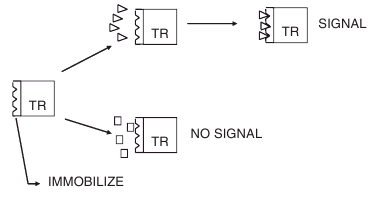
Fig 2. Specivity of biosensor. TR=Transducer

Immobilization of Bioreceptor

One major requirement for a biosensor is that the bioreceptor be immobilized in the vicinity of the transducer. The immobilization is done either by physical entrapment or chemical attachment. Chemical attachment often involves covalent bonding to transducer surface by suitable reagents. It is to be noted that only minute quantities of bioreceptor molecules are needed, and they are used repeatedly for measurements.

Transducer


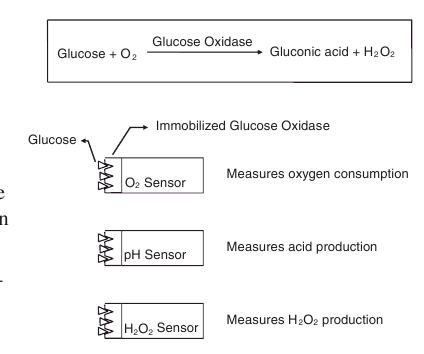
A transducer should be capable of converting the biorecognition event into a measurable signal (Figure 3). Typically, this is done by measuring the change that occurs in the bioreceptor reaction. For example, the enzyme glucose oxidase is used as a bioreceptor in a glucose biosensor that catalyzes the following reaction:

Fig 3. Three possible transducers for glucose measurement.


 To measure the glucose in aqueous solutions, three different transducers can be used:
  1. An oxygen sensor that measures oxygen concentration, a result of glucose reaction 
  2. A pH sensor that measures the acid (gluconic acid), a reaction product of glucose 
  3. A peroxidase sensor that measures H2O2 concentration, a result of glucose reaction
Note that an oxygen sensor is atransducer that converts oxygen concentration into electrical current. A pH sensor is a transducer that converts pH change into voltage change. Similarly, a peroxidase sensor is a transducer that converts peroxidase concentration into an electrical current.

Biosensor Characteristics


Biosensors are characterized by eight parameters. These are: 
  1. Sensitivity is the response of the sensor to per unit change in analyte concentration.
  2. Selectivity is the ability of the sensor to respond only to the target analyte. That is, lack of response to other interfering chemicals is the desired feature.
  3. Range is the concentration range over which the sensitivity of the sensor is good. Sometimes this is called dynamic range or linearity.
  4. Response time is the time required for the sensor to indicate 63% of its final response due to a step change in analyte concentration.
  5. Reproducibility is the accuracy with which the sensor’s output can be obtained.
  6. Detection limit is the lowest concentration of the analyte to which there is a measurable response.
  7. Life time is the time period over which the sensor can be used without significant deterioration in performance characteristics.
  8. Stability characterizes the change in its baseline or sensitivity over a fixed period of time. 

Considerations in Biosensor Development


Once a target analyte has been identified, the major tasks in developing a biosensor involve:
  1. Selection of a suitable bioreceptor or a recognition molecule.
  2. Selection of a suitable immobilization method.
  3. Selection and design of a transducer that translates binding reaction into measurable signal.
  4. Design of biosensor considering measurement range, linearity, and minimization of interference, and enhancement of sensitivity.
  5. Packaging of the biosensor into a complete device.
The first item above requires knowledge in biochemistry and biology, the second and third require knowledge in chemistry, electrochemistry and physics, and the fourth requires knowledge of  kinetics and mass transfer. Once a biosensor has been designed, it must be packaged for convenient manufacturing and use. The current trend is miniaturization and mass production. 

Modern IC (integrated circuit) fabrication technology and micromachining technology are used increasingly in fabricating biosensors, as they reduce manufacturing costs. Therefore, an interdisciplinary research team, consisting of the various disciplines identified above, is essential for successful development of a biosensor.

Biosensor References:

Biosensors: Theory and Applications
Biosensors: Theory and Applic...
Principles of Bacterial Detection: Biosensors, Recognition Receptors and Microsystems
Principles of Bacterial Detection
Mathematical Modeling of Biosensors: An Introduction for Chemists and Mathematicians (Springer Series on Chemical Sensors and Biosensors)
Mathematical Modeling of Biosensors

Engineering Biosensors: Kinetics and Design Applications
Engineering Biosensors: Kinetics..
Biosensors (The Practical Approach Series)
Biosensors (The Practical.....)
Electrochemical Sensors, Biosensors and their Biomedical Applications

Application of Ultrasound

Thursday, December 16, 2010


Ultrasound has many applications in our lifes. Below are some of the applications.

Medical
Ultrasound has a broad range of applications in medicine, where it is referred to as medical ultrasound.
It is widely used in obstetrics to follow the development of the fetus during pregnancy, in cardiology
where images can display the dynamics of blood flow and the motion of tissue structures (referred to as
real-time imaging), and for locating tumors and cysts. 3-D imaging, surgical applications, imaging from
within arteries (intravascular ultrasound), and contrast imaging are among the newer developments.


Ultrasonic leak detector

Industrial
In industry, ultrasound is utilized for examining critical structures, such as pipes and aircraft fuselages, for cracks and fatigue. Manufactured parts can likewise be examined for voids, flaws, inclusions, debonding, etc. Such defects can exist immediately after manufacturing, or were formed due to stresses, corrosion, etc. Ultrasound has also widespread use in process control. The applications are collectively called Non- Destructive Testing (NDT) or Non-Destructive Evaluation (NDE). In addition, acoustic microscopy refers
to microscopic examinations of internal structures that cannot be studied with a light microscope, such as an integrated circuit or biological tissue.

Underwater
Ultrasound is likewise an important tool for locating structures in the ocean, such as wrecks, mines, submarines, or schools of fish; the term SONAR (SOund Navigation And Ranging) is applied to these applications.

Range Measurements, Air
Ultrasound range measurements are used in cameras, in robotics, for determining dimensions of rooms, etc. Measurement frequencies are typically around 50 kHz to 60 kHz. The measurement concept is pulse-echo, but with burst excitation rather than pulse excitation. Special electronic circuitry and a thin low-acoustic-impedance air transducer is most commonly used. Rugged solid or composite piezoelectric-based transducers, however, can also be used, sometimes up to about 500 kHz.
  
Thickness Measurement for Testing, Process Control, Etc.
Measurement of thickness is a widely used application of ultrasound. The measurements can be done with direct coupling between the transducer and the object of interest, or — if good surface contact is difficult to establish — with a liquid or another coupling agent between the transducer and the object. Ultrasound measurements of thickness have applications in process control, quality control, measuring build-up of ice on an aircraft wing, detecting wall thickness in pipes, as well as medical applications. The instrumentation involves a broadband transducer, pulser-receiver, and display or, alternatively, echo detecting circuitry and numerical display.

Ultrasonic Flow Sensor
Doppler Flow Measurements
The flow velocity of a liquid or a moving surface can be determined through Doppler measurements, provided that the liquid or the surface scatters ultrasound back in the direction of the transducer, and that the angle between the flow direction and the ultrasound beam is known. Further details are given in the section about Doppler processing. CW and PW Doppler instruments are commercially available, with CW instrumentation being by far the least expensive.

Upstream/Downstream Volume Flow Measurements
When flow velocity is measured in a pipe with access to one or both sides, an ultrasound transmission technique can be used in which transducers are placed on the same or opposite sides of the pipe, with one transducer placed further upstream than the other transducer. From the measured difference in travel time between the upstream direction and the downstream direction, and knowledge about the pipe geometry, the volume flow can be determined. Special clamp-on transducers and instrumentation are available. An overview of flow applications in NDE is given in.

Elastic Properties of Solids
Since bulk sound speed varies with the elastic stiffness of the object, sound speed measurements can be used to estimate elastic properties of solids under different load conditions and during solidification processes. Such measurements can also be used for measurement of product uniformity and for quality assurance. The measurements can be performed on bulk specimens or on thin rods, using either pulse-echo or transmission instrumentation. Alternatively, measurements of the material’s own resonance frequencies can be performed for which commercial instruments, such as the Grindo-sonics, are available.

Porosity, Grain Size Estimation

Measurement of ultrasound attenuation can reveal several materials parameters. By observing the attenuation in metals as a function of frequency, the grain size and grain size distribution can be estimated. Attenuation has been used for estimating porosity in composites. In medical ultrasound, attenuation is widely used for tissue characterization, that is, for differentiating between normal and pathological tissues. Pulse-echo instrumentation interfaced with a digitizer and a computer for data analysis is required.

Acoustic Microscopy
The measurement approaches utilized in acoustic microscopy are similar to other ultrasound techniques, in that A-scan, B-scan, and C-scan formats are used. It is in the applications and the frequency ranges where acoustic microscopy differs from conventional pulse-echo techniques. Although acoustic microscopes have been made with transducer frequencies up to 1 GHz, the typical frequency range is 20 MHz to 100 MHz, giving spatial resolutions in the range from 100 µm to 25 µm. Acoustic microscopy is used for component failure analysis, electronic component packaging, and internal delaminations and disbonds in materials, and several types of acoustic microscopes are commercially available.


Ultrasonic Reference Books:

Ultrasonics: Data, Equations and Their Practical Uses
Ultrasonics: Data, Equations and Their Prac...
Physical Principles of Medical Ultrasonics
Fundamentals and Applications of Ultrasonic Waves (Pure and Applied Physics)
Fundamentals and Applications of Ultrasonic...

Piezoelectric Biosensor

Friday, November 19, 2010


Biosensors are chemical sensors that take advantage of the high selectivity and sensitivity of a biologically active material. It is well known that the resonant frequency of an oscillating piezoelectric crystal can be affected by a change in mass at the crystal surface. Piezoelectric immunosensors are able to measure a small change in mass.

A biosensor is an analytical tool consisting of biologically active material used in close conjunction with a device that will convert a biochemical signal into a quantifiable electrical signal. Biosensors have many advantages, such as simple and low-cost instrumentation, fast response times, minimum sample pretreatment, and high sample throughput. Although biosensors are beginning to move toward field testing and commercialization in the United States, Europe, and Japan, relatively few have been commercialized. Increased research in this area demands the development of novel materials, new and better analytical techniques, and new and improved biosensors. Some potential applications of biosensors are agricultural, horticultural and veterinary analysis; pollution, water and microbial contamination analysis; clinical diagnosis and biomedical applications; fermentation analysis and control; industrial gases and liquids; mining and toxic gases; explosives and military arena; and flavors, essences and pheromones.
 
A biosensor has two components: a receptor and a detector. The receptor is responsible for the selectivity of the sensor. Examples include enzymes, antibodies, and lipid layers. The detector, which plays the role of the transducer, translates the physical or chemical change by recognizing the analyte and relaying it through an electrical signal. The detector is not selective. For example, it can be a pH-electrode, an oxygen electrode or a piezoelectric crystal. Figure 1 describes a typical biosensor configuration that allows measurement of the target analyte without using reagents. 

The device incorporates a biological-sensing element with a traditional transducer. The biological-sensing element selectively recognizes a particular biological molecule through a reaction, specific adsorption, or other physical or chemical process, and the transducer converts the result of this recognition into a usable signal, which can be quantified. Common transduction systems are optical, electro-optical, or electrochemical; this variety offers many opportunities to tailor biosensors for specific applications. For example, the glucose concentration in a blood sample can be measured directly by a biosensor (which is made specifically for glucose measurement) by simply dipping the sensor into the sample.

Two classes of bio-recognition processes-bio-affinity recognition-and bio-metabolic recognition, offer different methods of detection. Both processes involve the binding of a chemical species with another, which has a complementary structure. This is referred to as shape-specific binding. In bio-affinity recognition, the binding is very strong, and the transducer detects the presence of the bound receptor-analyte pair. The most common types of processes are receptor-ligand and antibody-antigen binding. 

In bio-metabolic recognition, the analyte and other co-reactants are chemically altered to form the product molecules. The biomaterials that can be recognized by the bio-recognition elements are as varied as the different reactions that occur in biological systems. Table 1 lists a number of common analytes that could prove attractive for developing biosensors of appropriate specificity and sensitivity. 


Almost all types of biological reactions, (chemical or affinity), can be exploited for biosensors. The concept of shape-specific recognition is commonly used to explain the high sensitivity and selectivity of biological molecules, especially antigen-antibody systems. The analyte molecule has a complementary structure to the antibody, and the bound pair is in a lower energy state than the two separate molecules. This binding is very difficult to break. Table 2 summarizes a variety of biosystem-transducer combinations in terms of transducer, measurement mode and potential application.
 

The interaction of antibodies with their corresponding antigens is an attractive reason for attempting to develop antibody-based chemical biosensors, i.e. immunosensors. Theoretically, if an antibody can be raised against a particular analyte, an immunosensor could be developed to recognize it. Despite the high specificity and affinity of antibodies towards complementary ligand molecules, most antibody-antigen interactions do not cause an electronically measurable change. However, the remarkable selectivity of antibodies has fueled much research to overcome this intrinsic problem. The piezoelectric effect in various crystalline substances is a useful property that leads to the detection of analytes. Figure 2 shows a schematic diagram of an immunosensor device.

 The piezoelectric immunosensor is thought to be one of the most sensitive analytical instruments developed to date, being capable of detecting antigens in the picogram range. Moreover, this type of device is believed to have the potential to detect antigens in the gas phase as well as in the liquid phase.

A piezoelectric sensor that could reliably detect the mycobacterial antigen in biological fluids would be of enormous use. For instance, detection of the antigen in saliva could constitute a noninvasive method of screening high-risk populations. One tested piezoelectric crystal sensor gives results within a couple of hours after exposing the electrode to a liquid containing the antigen. The apparatus would be quite portable, so the immunological tests could be performed virtually anywhere, and the results could be obtained very quickly. 

Theoretical Principals


The basic equations describing the relationship between the resonant frequency of an oscillating piezoelectric crystal and the mass deposited on the crystal surface have been derived by Sauerbrey, Stockridge, and Lostis. Each followed a different path, but their final equations are similar, the Sauerbrey equation being the most widely accepted. In 1959, Sauerbrey developed an empirical equation for AT-cut quartz crystals vibrating in the thickness shear mode that describes the relationship between the mass of thin metal films deposited on quartz crystals and the corresponding change in resonant frequency of the crystal:
(1)

where, DF = frequency change in oscillating crystal in Hz, F = frequency of piezoelectric quartz crystal in MHz, DM = mass of deposited film in g, and A = area of electrode surface in cm2.

These relationships not only apply to film deposition but also to particulate deposition. When vibrating in the thickness-shear mode, the oscillating frequency of an AT-cut quartz crystal is given by: 

(2)
where F is the frequency of the crystal, N is the material constant (N = 1.66 MHz-mm for AT-cut quartz crystal), and a is the thickness of the crystal plate. Thus,


(3)
 for finite amount of change, we may write
(4)
Dividing Equation 4 by Equation 2 gives:
(5)
If the thickness is defined as
(6)
where M is the mass of the electrically driven portion of the crystal, A is the area of the electrically driven portion of the crystal, and r is the density of the crystal.

Assuming constant density, we have:
(7)
If the changes are finite,
(8)
Using Equation 6 yields
(9)
Thus,
(10)
Since F and M are constants, we may say:
DF = -k DM
(11)
The oscillating frequency of the crystal changes linearly with the change in mass on the crystal. The mass change occurs due to deposition of materials on the surface of the crystal. This relationship is only valid for small mass changes. For larger mass changes, it would be invalid since the density would change.

Equation 10 may also be stated as:
(12)
This shows that the term
 D
D
M
    
would increase if the base oscillating frequency of the crystal is increased. The term itself is the sensitivity of the crystal sensor, and Equation 12 shows that sensitivity is directly proportional to the base frequency of the crystal.

If a gas stream is sent flowing over the surface of the piezoelectric crystal and if it contains an analyte with concentration C, then
(13)
where C is the concentration of the analyte in the gas stream, DM is the mass of analyte in the gas stream, and V is the volume of the gas in the stream. The volume of the gas stream is related to the sampling time by the following relationship:

V = q · t
(14)
where q is the flow rate of the gas stream, and t is the sampling time. Equation 13 can be rewritten as:
(15)
where E is the collection efficiency of the coating material. If E is assumed to be equal to one and substituting Equation 15 into Equation 12, we may say
(16)
or
(17)
Thus, the change in the oscillating frequency of the crystal is related to both the sampling time and the concentration of the particles in the carrier gas. If we keep the sampling time, career gas flow rate and the mass of the analyte in the gas stream constant, we may restate Equation 17 as
DF = K C
(18)
Equation 18 shows that the change in frequency of the crystal is directly proportional to the concentration of the analyte in the gas stream flowing over it.

The piezoelectric crystal detector can be a very powerful analytical tool because of the relationship shown for the change in frequency to the analyte concentration with high sensitivity. Conversely, the above explanation shows that the crystal detector indiscriminately changes frequency due to the deposition of mass of any material on its surface. Thus, it is the task of the researcher to choose a coating that will undergo a highly selective chemical or physical binding with the substance to be detected. Only then can a highly selective sensor be constructed that will be sensitive to the subject to be detected.


Surface Plasmon Resonance Based Sensors (Springer Series on Chemical Sensors and Biosensors)Handbook of Biosensors and Biosensor KineticsHydrogel Sensors and Actuators: Engineering and Technology (Springer Series on Chemical Sensors and Biosensors)
Surface Plasmon Resonance Based Sensors (Sp...
$179.00
Handbook of Biosensors and Biosensor Kinetics
by Ajit Sadana
$590.00
Hydrogel Sensors and Actuators: Engineering...
$66.30
Nanomaterials for Biosensors (Nanotechnologies for the Life Sciences)Smart Biosensor Technology (Optical Science and Engineering)Nanostructured Materials for Electrochemical Biosensors (Nanotechnology Science and Technology Series)
Nanomaterials for Biosensors (Nanotechnolog...
$174.54
Smart Biosensor Technology (Optical Science...
$162.95
Nanostructured Materials for Electrochemica...
$89.00


Definition of Transducer, Sensor, and Actuator

Thursday, May 28, 2009

SENSOR EXAMPLE

There are many devices which have close meaning, eg: transducer, sensor, detector, and actuator. What is difference of each device?

A transducer is a device that converts a signal from one physical form to a corresponding signal having a different physical form. There for it is an energy converter. This means that the input signal always has energy or power.

There are six different kind of signal:
  • Mechanical
  • Thermal
  • Magnetic
  • Electric
  • Optical
  • Chemical
Any device converting signal of one kind to signal of a different kind is considered to be a transducer. The output signals can be of any useful physical form. The transducer can placed as input transducer or output transducer. An input transducer converts physical signal to electric signal while an output transducer converts electric signal to physical signal.

Another name of input and output transducers are sensor and actuator. Sensor is used to refer to the input transducer while actuator refers to the output transducer. Sensors are intended to acquire information, usually designed to handle LOW power and intended to consume energy as low as possible. Actuators are designed to power conversion and to handle (relatively) HIGH power.

Sensors monitor a measurand (a quantity to be measured) by taking advantage of how it affects a material or geometric property that causes a change in a measurable quantity (energy form). This quantity is either directly or indirectly converted into a form that is useful for processing. Functional design “around” the sensing mechanism may be required in order to yield a usable output signal.

Kindle Wireless Reading Device, Wi-Fi, 6" Display, Graphite - Latest Generation

Kindle Wireless Reading Device, Wi-Fi, 6" D...
$139.00


Sensor Classification:
Sensor can be classified by transduction principle, measurand, physical law, detection method, etc.
Transduction Principle
• Active sensor: a sensor that requires external power to operate. It converts form of input energy into form of output energy by using additional energy. Examples: the carbon microphone, thermistors, strain gauges, capacitive and inductive sensors, etc. Other name: modulating sensor, parametric sensors (output is a function of a parameter - like resistance)
Passive sensor: a sensor that generates its own electric signal and does not require a power source. It converts form of input energy into form of output energy without additional energy. Examples: thermocouples, magnetic microphones, piezoelectric sensors. Other name: self-generating sensors

Measurand:
• Electric sensors
• Magnetic
• Electromagnetic
• Acoustic • Chemical
• Optical
• Heat, Temperature
• Mechanical
• Radiation
• Biological
• Etc.

Physical law:
• Photoelectric
• Magnetoelectric
• Thermoelectric
• Photoconductive
• Magnitostrictive
• Electrostrictive
• Photomagnetic
• Thermoelastic
• Thermomagnetic
• Thermooptic
• Electrochemical
• Magnetoresistive
• Photoelastic
• Etc.

Application area:
• Consumer products
• Military applications
• Infrastructure
• Energy
• Heat
• Manufacturing
• Transportation
• Automotive
• Avionic
• Marine
• Space
• Scientific
• Etc.

Reference Books About Sensor:

Wireless Sensor Networks for Healthcare ApplicationsBioMEMS (Microsystems) Handbook of Transducers
Wireless Sensor Networks...    
by Terrance J. Dishongh
$79.20
BioMEMS (Microsystems)         
$126.44
Handbook of Transducers
by Harry N. Norton
$78.75